

.png?width=3200&height=1120&name=Educator%20Spotlight%20(2).png)
Caitlin Ritter teaches math across Grades 6-9 at a small district in Michigan. Her set-up is amazing because she gets to have the same kids for multiple years of their time in school! This lets her create amazing, strong relationships with her students and follow their learning journeys. Speaking of following learning journeys, she’s used Snorkl since the beginning - so she’s seen some of our earlier versions and is still with us years later 😅
The set-up
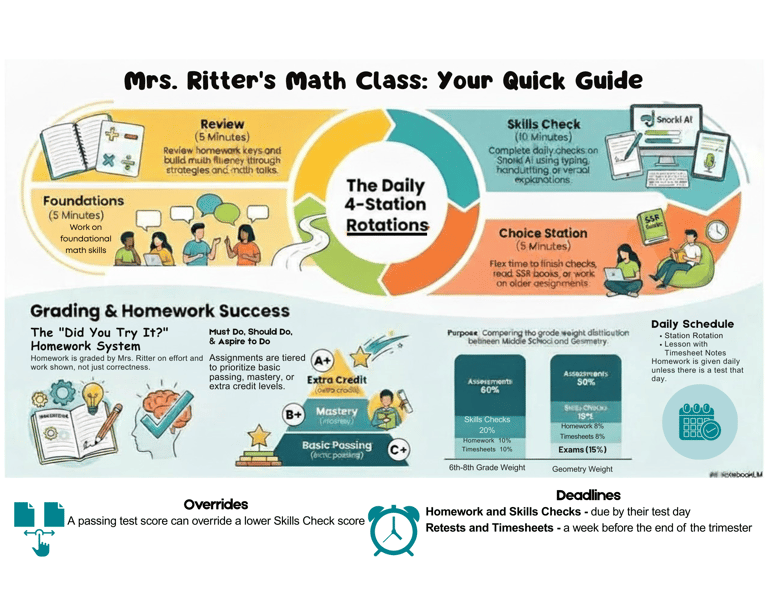
In her 1:1 Chromebook classroom using Illustrative Mathematics and Snorkl, she runs a four-station rotation model. Students rotate through different activities during the lesson: Foundations (5 minutes), Review (5 minutes), Skills Check (10 minutes), and a Choice Station (5 minutes). Snorkl is used as the Skills Check rotation - to check for understanding in the form of a daily mini-quiz on the previous day’s lesson and homework. The focus is not just on correctness but on the explanation of thinking.
What we love and agree with is that some math is best done on paper! Many of the student responses are a combination of explanation of thinking done verbally combined with a picture of a graph or multi-step equation done in the IM paper workbook. Overall, her students are using every tool in their toolbox to explain their thinking - they speak, write, draw, and upload images as part of their Snorkl responses.
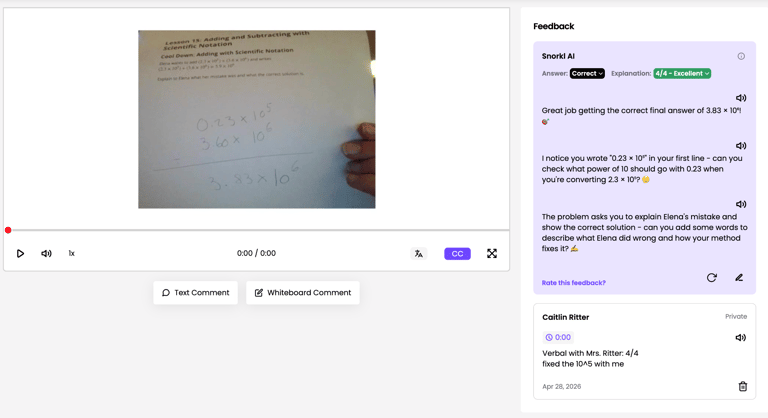 (Also shout out to the extra feedback she’s written here! Not pictured: video feedback she’s also left on some of her students’ responses.)
The routines:
Her classroom has amazing routines in place that have developed over time. She uses the highest score of all submissions (many of her students submit 4-5 responses to get Excellent!) and quickly refers to the color coding to see who might need additional support. Beyond that, because this is not the first year students have used Snorkl, students are more likely to dig in and explore the question further when they immediately get 4/4’s. If students disagree with the initial feedback or score, they’ll have a meaningful mathematically rich discussion about it (which we love for building metacognition!)
As an example:
An open ended ratio problem asked: “How many people out of 100 would have a cat if every 2 out of 10 people have a cat?”. A student responded with 20%, which is absolutely true, but not what the question is asking. Caitlin was able to ask “did you answer the question” when the student asked questions about her feedback - giving them the opportunity to have more meaningful math conversations about percentages and representations.
The pro tips and the why of it all:
It is wildly important to get students immediate feedback, especially if it’s about a common math misconception. If time passes in between feedback and revision, it’s less impactful and likely to stick.
Her advice to newcomers? Just try it out as a student. Put on your middle school student hat and submit an “idk”, incomplete, or off-topic response to see how Snorkl responds. Then see if you can use feedback to revise and get a 4/4 through different representations of thinking.
And, because Caitlin’s a seasoned Snorkl user, we picked up some moves that we would recommend:
- Using Snorkl as an objective, third party voice - one that can surface new talking points for discussion to build metacognition.
- Using Snorkl’s Read Aloud feature to read directions and feedback to students who may have reading comprehension difficulties - a great discreet benefit for students!
Lastly, fun tidbit for all the math teachers out there - her class gets to Geometry before Algebra, so they’ll encounter circles before exponents. To check what additional foundational skills she might have to teach, her students will be using Snorkl as more of an introductory piece, as a preemptive check for understanding before heading into writing the formula for circles.
If you think in equations like we do here at Snorkl, at the end of the day, it’s a math equation: 1 minute per student x 30 students to give individual feedback, you only have that leftover time to do core instruction, reteaching, scaffolding, all while facilitating connections and discussion.
---